
Remote Customer Service Interview Questions and Answers Guide

Landing a work-from-home customer service job is an exciting step. Companies hiring for remote roles look for people who can work well on their own. They want to know that you communicate clearly, stay calm under pressure, and have a reliable home office setup. If you are preparing for Remote Customer Service Interview Questions, these are the skills you need to show.
If you are preparing for your next interview, you need more than basic questions. You need practical examples and simple answers that show your skills. This guide covers the top customer service interview questions, sample answers, and practical tips to help you prepare with confidence. If you’re still looking for a role, explore these work-from-home customer service jobs for entry-level opportunities.
What Do Interviewers Look for in Customer Service Candidates?
Most customer service employers look for people who can:
- Communicate clearly
- Listen to customers
- Stay calm under pressure
- Solve problems
- Show empathy
- Manage time well
- Work without close supervision
- Protect customer information
Your answers should show these skills with real examples when possible.
Core Customer Service Interview Questions
These questions test your basic customer service skills, attitude, and work experience.
1. Tell Me About Yourself and Your Support Background
What they mean
The interviewer wants a short summary of your work background and skills. They also want to know why you are a good fit for the role.
Sample answer
“I have two years of customer support experience. I helped customers with technical and billing issues. I enjoy listening to customers and finding simple solutions. I am now looking for a remote role where I can use my communication and problem-solving skills.”
Tip: Keep your answer short. Focus on skills related to customer service.
2. What Does Excellent Customer Service Mean to You?
What they mean
They want to understand how you treat customers.
Sample answer
“Great customer service means making customers feel heard, valued, and respected. It means solving their problem while also giving them a positive experience.”
A good answer should show empathy, patience, and problem-solving.
3. What Skills Should a Great Customer Service Representative Have?
What they mean
The interviewer wants to know if you understand the skills needed for daily support work. Want to understand what the job involves? See our guide to customer service representative duties and resume bullet examples.
Sample answer
“A great customer service representative needs clear communication, empathy, patience, and strong problem-solving skills. They should also stay calm under pressure and keep accurate customer notes.”
Key Customer Service Skills
The chart below gives a simple visual breakdown of these core skills.
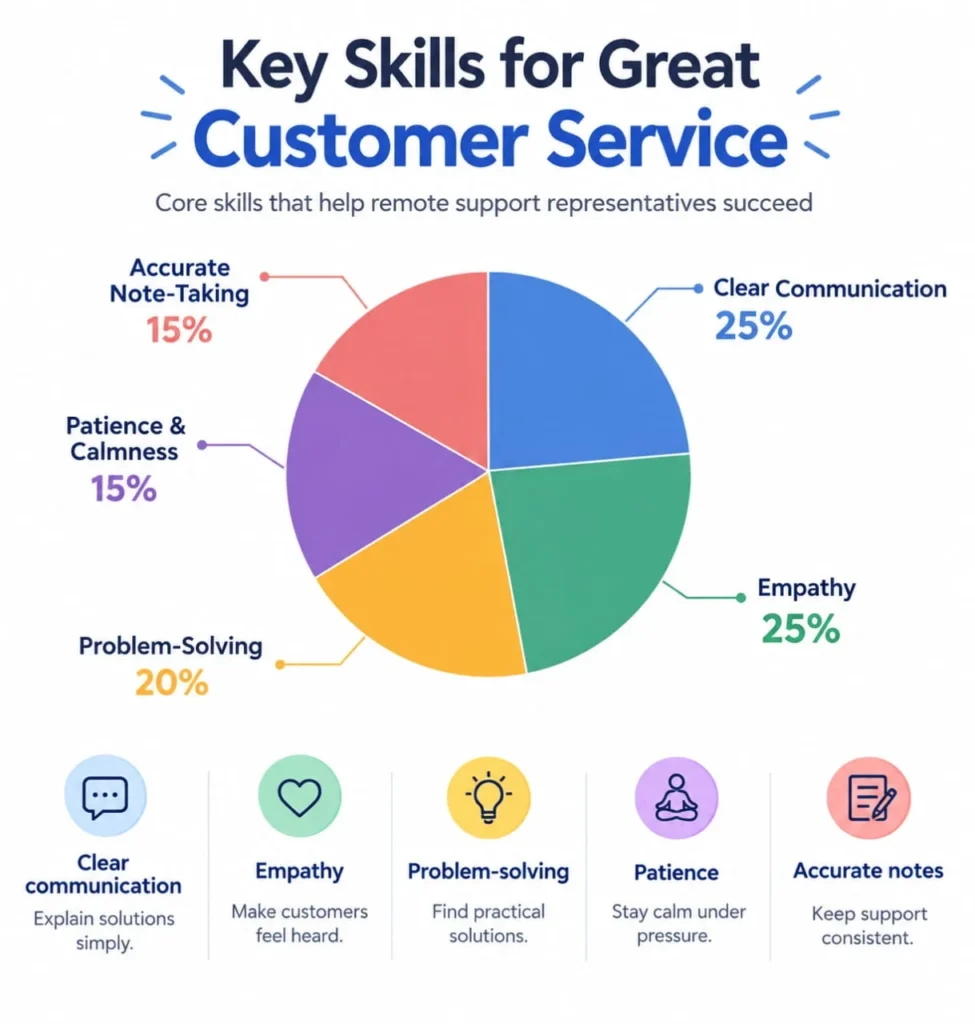
Note: The percentages are an illustrative breakdown, not industry survey data.
Remote Customer Service Interview Questions
Remote customer service jobs come with extra challenges.
You may need to manage your time, solve technical problems, and stay productive without a manager sitting nearby.
4. How Do You Manage Your Time While Working From Home?
What they mean
The interviewer wants to know if you can stay focused and complete your work on time.
Sample answer
“I plan my work before my shift starts. I use a digital planner and time blocks to manage my tasks. I also keep personal distractions away during work hours so I can stay focused on customers.”
Quick Tip
Show that you can:
- Follow a schedule
- Meet deadlines
- Stay focused
- Handle several tasks
5. Can You Describe Your Home Office Setup and Internet Reliability?
What they mean
Remote support often requires a stable internet connection, computer, headset, and quiet workspace.
Sample answer
“I have a quiet workspace where I can focus during work hours. I use a reliable high-speed internet connection and a good headset. I also keep a mobile hotspot available as a backup.”
Tip: Only mention equipment you actually have.
6. How Do You Keep Your Home Office Secure?
What they mean
Customer service workers may handle private customer information. Employers want to know that you understand basic data security.
Sample answer
“I lock my computer whenever I step away. I work in a private space and make sure other people cannot see customer information. I also follow the company’s security and data privacy rules.”
Scenario-Based Customer Service Interview Questions
These questions show how you react when things go wrong. A strong answer should explain what you would do and why.
7. How Would You Handle an Angry Customer Asking for an Immediate Refund?
Example situation
A customer is angry because their package arrived late. They want a full refund, but company policy only allows partial store credit.
Best answer
“First, I would stay calm and listen to the customer. I would show empathy and apologize for the trouble. Then I would check what options are available under company policy. I would explain the options clearly and try to find the best solution I can offer.”
Remember
Listen → Show empathy → Check the policy → Offer a solution
8. How Would You Handle a Customer Upset About a Known Issue?
Example situation
A system problem is causing login errors, and many customers are contacting support.
Best answer
“I would acknowledge the problem and apologize for the disruption. I would explain what information is available about the issue and give the customer a realistic update. If possible, I would follow up when there is new information.”
Do not promise a fix time unless the company has confirmed it.
9. What Would You Do If You Did Not Know the Answer?
Example situation
A customer asks about a technical feature you have never used.
Best answer
“I would not guess. I would tell the customer that I want to give them the correct answer. Then I would check the company’s knowledge base or ask a senior team member. I would return with accurate information as quickly as possible.”
This shows honesty, responsibility, and problem-solving.
Customer Service Interview Questions About Tools and AI
Modern support teams use software to manage customer questions. Some teams also use AI to save time.
10. What Customer Service Tools Have You Used?
What they mean
The interviewer wants to know if you have experience with helpdesk and communication tools.
Sample answer
“I have used tools such as Zendesk, Salesforce, and Intercom to manage tickets and customer chats. I also learn new tools quickly by reading documentation, practicing, and learning from teammates.”
If you have not used these tools, do not claim that you have. Instead, explain how quickly you learn new software. If you’re ready to look for these roles, learn how to get remote customer service representative jobs.
11. How Do You View AI Tools in Customer Service?
What they mean
Employers want to know if you can use AI responsibly.
Sample answer
“I see AI as a helpful support tool. It can help draft responses, summarize conversations, and save time. But customer service still needs human judgment, empathy, and careful problem-solving.”
Important
Always check AI-generated information before sending it to a customer.
AI can be useful. It can also confidently invent nonsense, which is one of humanity’s more impressive technological traditions.
Use the STAR Method for Behavioral Questions
The STAR method can help you give clear answers to questions about past situations.
S = Situation
Explain what happened.
T = Task
Explain what you needed to do.
A = Action
Explain the steps you took.
R = Result
Explain what happened after your action.
Simple Example
Situation: A customer was upset about a delayed order.
Task: I needed to solve the issue and keep the customer informed.
Action: I checked the order, explained the delay, and offered the available solution.
Result: The customer accepted the solution and the issue was resolved.
Tip: Focus most of your answer on the Action and Result.
Quick Customer Service Interview Checklist
Use this checklist before your interview:
☐ Test your internet connection
☐ Check your microphone and headset
☐ Test your webcam
☐ Choose a quiet workspace
☐ Clean your background
☐ Use good front lighting
☐ Dress professionally
☐ Keep your resume nearby
☐ Keep a notebook and pen ready
☐ Prepare 2–3 questions for the interviewer
Final Tips for Your Remote Customer Service Interview
A strong interview is not about giving perfect answers. It is about showing that you can listen, communicate clearly, stay calm, and solve problems. You can also explore specific employer opportunities, such as Apple customer service remote jobs.
For more interview preparation tips, review the basic steps before your interview.
- Practice your answers out loud.
- Prepare real examples from your experience.
- Learn about the company.
- Check your technology early.
- Keep your answers clear and focused.
- Never pretend to know something you do not know.
Most importantly, show the interviewer that you can make customers feel heard, respected, and supported. Preparing for Remote Customer Service Interview Questions can help you feel more confident and ready for your interview
Frequently Asked Questions
Freshers may be asked about communication, patience, teamwork, problem-solving, handling difficult people, and time management. You can use examples from school projects, volunteer work, internships, retail work, or other situations where you helped people.
Use the STAR method when the interviewer asks about a past experience. Explain the Situation, Task, Action, and Result in a short story. Focus most of your answer on what you did and what happened after your action.
Healthcare and other specialized customer service roles may include questions about privacy, data security, confidential information, strict procedures, and sensitive situations. Your answers should show that you understand the importance of accuracy, privacy, and following company rules.
Some employers provide equipment for remote customer service workers. This may include a laptop, keyboard, mouse, or headset. Equipment policies vary by company, so always check the job posting or ask the employer before accepting the role


