
STAR Method Interview Guide: Free Examples & Formulas (2026)

Mastering the STAR method is one of the easiest ways to structure your interview answers and demonstrate your skills during a job interview. Hiring managers do not want long, confusing stories. They want clear, simple answers that show how you solve real problems at work.
This complete guide breaks down what the STAR method is, how to split your speaking time, real customer service script examples, and common mistakes to avoid.
Quick STAR Method Summary
S (Situation – 15%): Set the story background in 1 to 2 short sentences.
T (Task – 10%): Explain your main goal in 1 sentence.
A (Action – 55%): Describe the exact steps you took. This is the most important part!
R (Result – 20%): Share the positive outcome using numbers or facts.
Best For: Behavioral questions that start with “Tell me about a time when…”
What Is the STAR Method?
The STAR method is a simple step-by-step formula for answering interview questions.
Interview questions often start with “Tell me about a time you…” These are called behavioral questions. They test how you handled past job situations to understand how you may approach similar situations in a new role.
The STAR method helps structure clear answers to behavioral interview questions. Indeed – STAR Interview Technique
Instead of rambling, the STAR formula keeps your story organized into four clear parts: Situation, Task, Action, and Result. Remote hiring managers can use this method to keep answers focused, professional, and easy to follow during phone or video interviews.
Why Employers Use STAR Questions
When companies hire work-from-home agents for live chat, phone support, or technical help, they cannot watch you work in person. They use STAR questions to evaluate your core customer service skills, decision-making, and ability to handle difficult situations.
Employers use these questions to check if you can:
- Stay calm when talking to angry customers.
- Solve computer software or internet issues quickly.
- Work well on your own without a boss watching you.
- Handle high chat volumes during busy hours.
The 4-Step STAR Method Framework
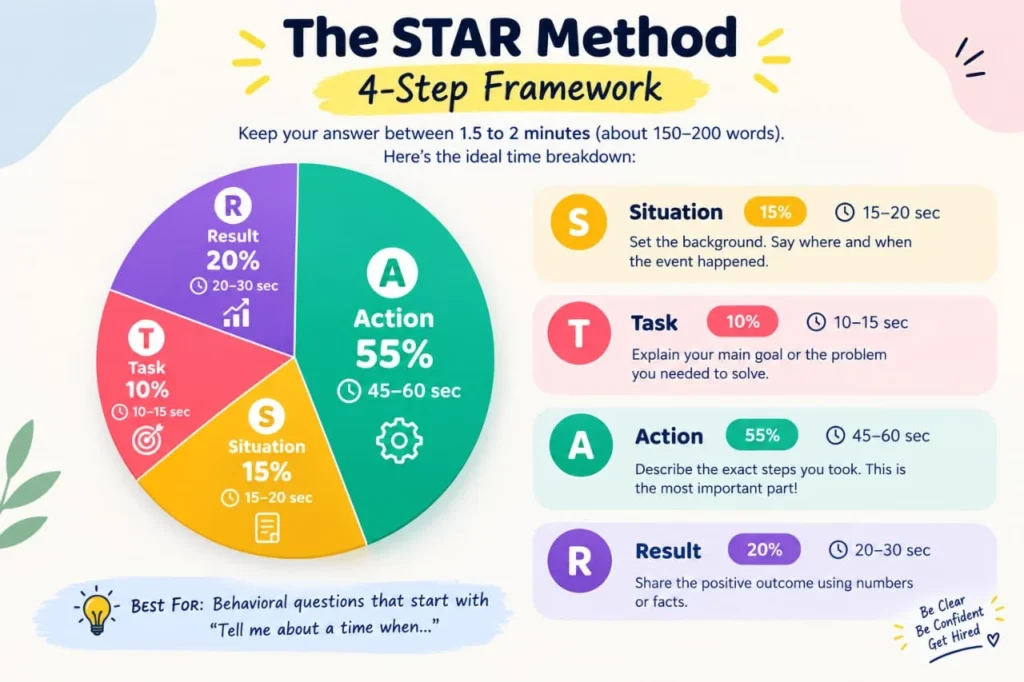
Keep your total answer between 1.5 to 2 minutes or about 150 to 200 words. Use this simple timing breakdown:
| STAR Step | Speaking Time | Time Allocation | Main Objective |
|---|---|---|---|
| Situation | 15 to 20 seconds | 15% | Briefly explain where and when the event happened. |
| Task | 10 to 15 seconds | 10% | State the main problem you needed to solve. |
| Action | 45 to 60 seconds | 55% | Detail your personal steps, tools, and decisions. |
| Result | 20 to 30 seconds | 20% | Share the final success using numbers or facts. |
1. Situation (15% of Your Time)
Give a brief background. Name the company, your job title, and what was happening.
Good Example:
“In my last job as a remote chat agent, our delivery system went down during the busy holiday season.”
Bad Example:
Spending two full minutes talking about company history, warehouse locations, and delivery truck routes.
2. Task (10% of Your Time)
State your exact job or goal in that situation.
Good Example:
“My task was to help over 30 worried buyers each hour and prevent order cancellations.”
Keep this section short. The interviewer mainly wants to understand what you were responsible for accomplishing.
3. Action (55% of Your Time)
This is the main part of your answer. Explain the exact steps you took. Always say “I” instead of “We” when describing your individual contribution.
- Name specific customer service tools you used, such as Zendesk, LiveChat, Slack, or CRM software.
- Explain how you stayed patient and polite.
- Describe how you identified and fixed the problem step-by-step.
- Focus on decisions you personally made.
4. Result (20% of Your Time)
End your story with a strong, positive outcome. Use numbers, percentages, or customer satisfaction scores whenever possible.
Good Example:
“As a result, I saved 85% of delayed orders from cancellation and maintained a 98% customer satisfaction score for the week.”
If you do not have exact numbers, you can describe a measurable outcome, customer feedback, manager feedback, or another clear result.
Real STAR Method Examples for Remote Jobs
Here are three complete answer scripts for remote customer support and call center interviews.
Example 1: Handling an Angry Customer
Question: “Tell me about a time you dealt with a very angry customer.”
Situation: While working as a remote chat support agent, a customer opened a ticket yelling about a missing $200 package marked as delivered.
Task: I needed to calm the customer down, track the package, and resolve the issue politely.
Action: I acknowledged their frustration and promised to investigate the issue. I checked our delivery system and saw that the driver had dropped the box at a neighbor’s house by mistake. I contacted the local courier lead while giving the customer regular updates through chat.
Result: The driver retrieved the package within one hour. The customer thanked me for the fast updates and gave my support session a 5-star review.
Example 2: Fixing a Tech Issue at Home
Question: “Describe a time you faced a technical problem while working from home.”
Situation: During a big sales event, my main home internet went down while I was handling three active customer chats.
Task: I needed to protect customer data, stay online, and avoid dropping my support queue.
Action: I switched to my backup mobile hotspot within 30 seconds. Next, I sent a quick message on Slack to inform my team leader. I then finished all active chat sessions smoothly while monitoring my connection.
Result: I experienced zero interruption to my customer support work, maintained my target reply speed, and resolved all active customer tickets before my main internet connection came back.
Example 3: Managing Heavy Workloads
Question: “Give an example of how you handle stress during busy hours.”
Situation: At my previous remote call center jobs position, our team experienced a 40% surge in customer tickets due to a payment system glitch.
Task: My goal was to lower customer wait times while keeping my work accurate.
Action: I used quick-response templates for common payment questions to speed up first replies. I answered urgent billing questions first and sent complex software bugs to our technical team.
Result: I handled 65 tickets in one shift—20% above the daily team average—and helped bring overall customer wait times down from 15 minutes to under 3 minutes.
Interactive Practice: Test Your Knowledge
Try this quick test to check if you can identify the correct STAR component.
Scenario: You are asked, “How do you handle tight deadlines?”
Which option is the BEST Action (A) statement?
- Option A: “I worked at a busy marketing agency with daily deadlines.”
- Option B: “I created a daily task priority list in Trello and muted non-urgent chat notifications.”
- Option C: “My manager praised my work and gave me a performance bonus.”
Correct Answer: Option B
Why: Option B explains the specific personal steps and tools (Trello) used to solve the problem. Option A is a Situation (S) statement, and Option C is a Result (R) statement.
Common STAR Method Mistakes to Avoid
Avoid these four common errors when answering behavioral questions:
- Rambling on the Background
Do not waste time explaining unnecessary backstory details. Keep the Situation and Task brief so you have enough time to explain your Actions.
- Saying “We” Instead of “I”
Interviewers want to know what you did. If you worked as part of a team, explain the team situation briefly and then focus on your own contribution.
- Forgetting the Result
Never stop your story immediately after explaining the Action. Always explain how things turned out in the end.
- Making Up Fake Stories
Experienced interviewers may ask follow-up questions. Whenever possible, use genuine experiences from previous jobs, school projects, volunteer work, internships, or other relevant experiences.
Final Thoughts for Success
Practicing the STAR method can make your interview answers more organized and help you communicate your experience clearly. Write down 3 to 5 strong stories from your past experience, fit them into the four-step framework, and review them before your interview.
Once you have practiced your STAR answers, you can also learn how to pass your job assessment test and prepare with our guide to customer service interview questions before your next remote job interview.
Remember: keep your Situation and Task short, spend most of your answer explaining your Actions, and finish with a clear Result.
Frequently Asked Questions
Five common STAR questions include handling an unhappy customer, fixing a mistake, setting priorities under pressure, learning new software quickly, and working with a difficult team member.
A complete STAR answer should generally take between 1.5 to 2 minutes, or approximately 150 to 200 words. Spend most of that time explaining your specific actions.
Yes. If you are applying for entry-level work-from-home jobs, you can use genuine examples from school assignments, group projects, volunteer work, internships, or other relevant experiences.
If you do not remember exact numbers, share a specific outcome, such as positive customer feedback, a manager review, or a successful resolution.


