Why Your Resume Isn’t Getting Interviews: 10 Mistakes (Fix #3)
Your resume is not getting interviews mainly because it does not clearly match the job requirements, lacks the right keywords, and has small formatting or clarity issues that recruiters and ATS systems reject within seconds. Learn how an ATS works in our guide on What Is an ATS Resume. If You’ve Applied to 20+ Jobs and Heard Nothing, Read This First
You are not unqualified your resume is simply not doing its job.
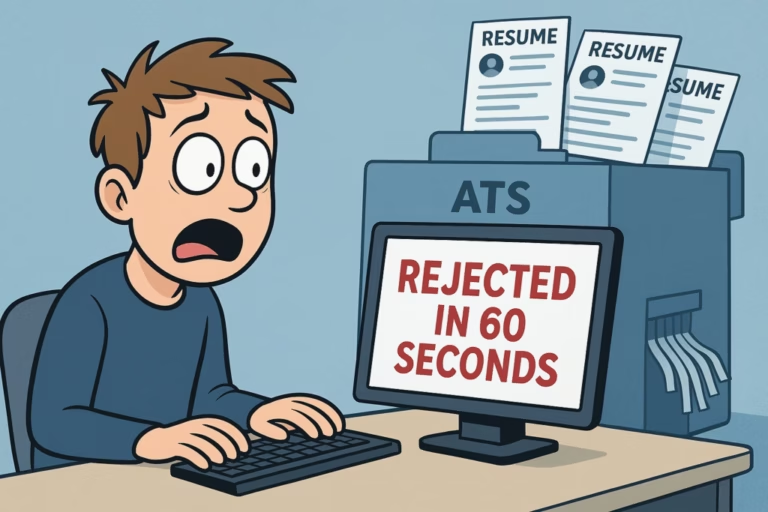
Here is the hard truth: Recruiters spend only 6 to 7 seconds on your resume. During that time, they are not reading every word. Instead, they are looking for three things:
- Relevance — Does this person fit the job?
- Clarity — Can I read this fast?
- Results — Did this person actually do good work?
If your resume fails even one of these, it gets rejected. Quietly. Without any feedback.
According to Jobscan research, 75% of resumes are filtered out by ATS software. That means most job seekers lose the game before it even starts.
But here is the good news: Every single mistake that gets resumes rejected is fixable. Most of them take under 10 minutes.
Throughout this guide, you will learn exactly what is wrong. Then, you will learn precisely how to fix it.
So let’s get started.
Resume Not Getting Interviews? 10 Fixes You Must Know
Struggling to land interviews? Here are 10 quick fixes to optimize your resume and get noticed by employers!
Mistake 1: Sending the Same Resume to Every Job
First of all, let’s talk about the biggest mistake which stop your CV to gat interview. A generic resume feels like a mass email. Because of this, ATS systems cannot match your resume to the job. As a result, even if you are perfect for the job, you get filtered out automatically.
So here is the quick fix:
- Step 1: Read the job posting carefully.
- Step 2: Highlight the skills that appear again and again.
- Step 3: Add those exact words to your experience section.
- Step 4: Rewrite your summary for that specific job.
For example, look at the difference:
| ❌ Weak Version | ✅ Strong Version |
|---|---|
| “Managed teams and delivered projects on time.” | “Project manager with 3 years of Agile experience, leading cross-functional teams of 8 to 12 members across full product delivery cycles.” |
As you can see, same person. But completely different result.
Mistake 2: Missing Keywords Recruiters Search For
Next, let’s talk about invisible resumes.
Recruiters search for specific tools, certifications, and role names. Therefore, if those words are not in your resume, you are completely invisible. Not only to ATS filters, but also to human recruiters. Choosing the right skills matters too. Check Top Skills to Put on a Resume That Get You Hired Fast.
So here is what to do:
- First, copy the job description into Jobscan or WordCloud.
- Then, find the words that appear the most.
- Finally, add those words naturally to your summary, skills, and experience.
In addition, here are common keywords that most people miss:
| Industry | Keywords Most People Forget |
|---|---|
| Marketing | SEO, Google Analytics, CRO, Meta Ads |
| Tech | Python, Agile, REST API, CI/CD |
| Finance | Financial modeling, SAP, variance analysis |
| HR | HRIS, talent acquisition, onboarding |
Mistake 3: Listing Duties Instead of Achievements on Your Resume
Now, this is the mistake that kills most resumes.
You see, every person with your job title did the same duties. However, results tell recruiters whether you were actually good at the job.
So use this simple formula:
Action Verb + What You Did + Number or Result
| ❌ Weak (Duties) | ✅ Strong (Achievements) |
|---|---|
| Managed social media | Grew Instagram from 4K to 22K followers in 6 months |
| Handled complaints | Reduced resolution time by 40% through new ticketing system |
| Wrote blog content | Drove 18K monthly organic visitors through 30 SEO articles |
What if you don’t have numbers yet?
No problem. Use team size, project scope, time saved, or your ranking instead.
For instance: “Led a team of 5 to launch the company’s first mobile app in 4 months.”
Mistake 4: Weak Resume Summary
If you are searching Why Employers Are Not Responding to my Resume let’s fix your summary.
In fact, your summary is the first thing recruiters read. If it says “hardworking professional seeking opportunities,” you have already lost them. If you have no experience, read How to Write a Resume With No Work Experience for better resume tips.
So here is a simple structure you can copy:
[Your Role] with [X years] experience in [specific area]. Proven ability to [biggest achievement]. Seeking to bring [your value] to [type of company].
| ❌ Weak | ✅ Strong |
|---|---|
| “Motivated professional looking for growth opportunities.” | “Digital marketing specialist with 4 years in SEO and paid social. Helped three SaaS brands cut cost per lead by 32% through data-driven campaign strategy.” |
As a result, the strong version tells the recruiter exactly who you are and what you can do. In other words, it earns the next 6 seconds of their time.
Mistake 5: Formatting That Loses Recruiters Instantly
Moreover, bad formatting gets your resume skipped immediately.
Creative templates with columns and graphics break ATS parsers. That means your information never gets read properly. Your resume file format also matters. Read our guide on Resume Format: PDF or Word? before applying.
So follow these rules:
| ✅ Do This | ❌ Don’t Do This |
|---|---|
| Single-column layout only | Two-column layouts |
| Font size 10-12pt body | Font smaller than 10pt |
| Calibri, Arial, or Garamond | Times New Roman or fancy fonts |
| Same bullet style everywhere | Mixing bullets, dashes, and arrows |
In addition, do this simple test:
Paste your resume into Notepad. If it reads clearly, you are ATS-safe.
Mistake 6: Spelling and Grammar Errors
Furthermore, even one typo can ruin your chances. A single spelling mistake signals carelessness. Since attention to detail matters in every job, one error creates a red flag that is very hard to fix. If you use AI tools, read Can ATS Detect ChatGPT to avoid common resume mistakes.
So here is your 3-step fix:
- First, run your resume through Grammarly
- Then, read it out loud slowly.
- Finally, ask one other person to check it.
As a result, you will catch errors that your brain automatically skips.
Mistake 7: Irrelevant Information
On top of that, every irrelevant line pushes your best stuff further down. Because of this, recruiters may never reach your most impressive qualifications.
So remove these things right now:
| ❌ Remove This | ✅ Why |
|---|---|
| Jobs from 10+ years ago | They don’t matter anymore |
| High school details (if you have a degree) | Wastes valuable space |
| Age, religion, or photo | Not needed in 2026 |
| “References available upon request” | Everyone knows this |
In short, ask yourself: “Does this make me more qualified for THIS job?” If the answer is no, cut it.
Mistake 8: An Outdated Resume That No Longer Works
Equally important, your resume changes over time. It’s also important factor to update your resume before rejected and getting no interviews from recruiters.
To clarify, skills evolve fast. Therefore, a resume that you haven’t touched in 6 months is probably missing new tools, certifications, and wins.
So here is a pro tip:
Keep a running notes file on your phone. Every time you finish a project or learn something new, write it down. Then, updating your resume takes 20 minutes instead of 2 hours.
Mistake 9: Missing or Mismatched LinkedIn Profile
In addition, recruiters always check LinkedIn after your resume.
According to LinkedIn’s hiring data, complete profiles get 40 times more opportunities than incomplete ones.
So make sure:
- Your job titles and dates match exactly between resume and LinkedIn.
- Your LinkedIn headline is more than just your job title.
Use this formula for your headline:
[Title] helping [who] achieve [what] through [how]
For example: “SEO Specialist helping e-commerce brands grow organic traffic through data-backed content strategy”
Mistake 10: Wrong or Missing Contact Information on Your Resume
Last but not least, this one is silent and deadly.
Imagine this: A recruiter loves your resume. They try to call you. But the number is wrong. Or the email bounces.
As a result, your application dies forever. And you never find out why.
So before every single submission, check these:
| ✅ Check This | ✅ How |
|---|---|
| Phone number | Call yourself to test it |
| Use firstname.lastname@gmail.com | |
| LinkedIn URL | Make sure it opens and looks clean |
| Portfolio links | Click every link to confirm it works |
Why Resumes Get Rejected in 7 Seconds
To sum up, recruiters are not reading in those first 7 seconds.
Rather, they are asking three quick questions:
| Question | Answered By |
|---|---|
| Is this person relevant? | Your title and summary |
| Can I read this fast? | Your formatting |
| Do they show results? | Your bullet points |
If any answer is no, the resume is rejected.
Therefore, your only job is to make all three answers a clear “YES.”
Resume Not Getting Interviews? Pre-Submission Checklist
Before you apply to any job, run through this list. No exceptions.
Tailoring
- Resume customized for this specific job
- Keywords from the job description included naturally
- Summary rewritten for this exact role
Content
- Every bullet point shows an achievement, not just a duty
- At least one number or measurable result per job
- All irrelevant information removed
Technical
- ATS-safe formatting confirmed (Notepad test passed)
- Clean, single-column layout
- One to two pages maximum
Accuracy
- Zero spelling or grammar errors
- Contact information tested and working
- LinkedIn profile matches resume exactly
How to Test if Your CV Is Ready for Interviews
Before you apply for any job, do this quick 5-minute resume test.
- Open the Job Description
Read the job post again and check the most important skills, tools, and responsibilities the employer wants.
- Compare It With Your Resume
Now match your resume with that job post. Ask yourself: are the same skills and role-related keywords clearly visible?
- Scan Your Resume in 7 Seconds
Look at your resume for only 7 seconds, just like a recruiter. Can you quickly see your job title, experience, and best achievements?
- Paste It Into Notepad
Copy your resume and paste it into Notepad. If the formatting looks messy or hard to read, your ATS may also struggle to read it.
- Ask Someone Else to Review It
A fresh pair of eyes can catch mistakes you miss. Let a friend, mentor, or colleague review it before you apply.
- Quick Rule
If your resume is clear, relevant, and easy to scan, interview chances increase much faster.
A strong cover letter also helps. Read our Cover Letter for Remote Job guide before applying.
Final Word
After reading this informative post on why your resume is not getting interviews, we can say that the job market is tough right now. But here is what most people don’t realize: Your competition is making the exact same mistakes you just read about.
So if you do these five things, you will be ahead of 90% of applicants:
- Fix your keywords.
- Add numbers to every bullet point.
- Clean your formatting.
- Tailor every single application.
- Match your LinkedIn to your resume.
These are not hard changes. They are simple improvements that most people never make.
Now you know exactly what to fix. So your next application should look completely different from every one you sent before.
Frequently Asked Questions
Most likely, your resume is missing the right keywords for ATS filters. Or, it is not tailored to each job. Or, it does not show measurable achievements. Start by customizing your resume for each job posting and adding relevant keywords naturally.
First, use a clean single-column layout. Then, include exact keywords from the job description. Also, avoid tables, columns, and graphics. Finally, paste your resume into Notepad. If it reads clearly, you are ATS-safe.
In general, one page if you have under 10 years of experience. However, two pages are okay if you have a lot of relevant experience. But never add filler just to fill space. Every line must earn its place.
To begin with, recruiters scan your name, title, and summary. Then, they check your most recent job. After that, they look at your bullet points for results. Finally, formatting decides how much attention they give the rest.
According to The Ladders eye-tracking study, recruiters spend 6 to 7 seconds on initial resume screening. During that time, they scan for relevance and readability. They are not reading every word.
Absolutely yes. Your summary is the first text a recruiter reads. A strong summary immediately shows your value. A weak one makes recruiters lose interest before they reach your experience.