How to Explain a Career Gap on Your Resume (2026 Guide)

To explain a career gap on your resume, just add a clear label in your work history. Use exact dates and write one short line about why you took a break (like family care or learning new skills). In my experience hiring for remote roles, recruiters don’t mind a break—they just hate a blank space. Keep it honest and short.
Yes, you can get hired with a career gap. The gap is not the problem but he explanation is.
Recruiters want clear history, not perfect history.
Here is the simplest way to write it:
Career Break | Jan 2023 – Mar 2024
Family care and learning
– Completed Google Project Management Certificate
– Managed care schedules and household operations
That single entry answers every question. You can also write a resume with no work experience using this guide: Resume with No Work Experience.
How to Explain a Career Gap on Your Resume
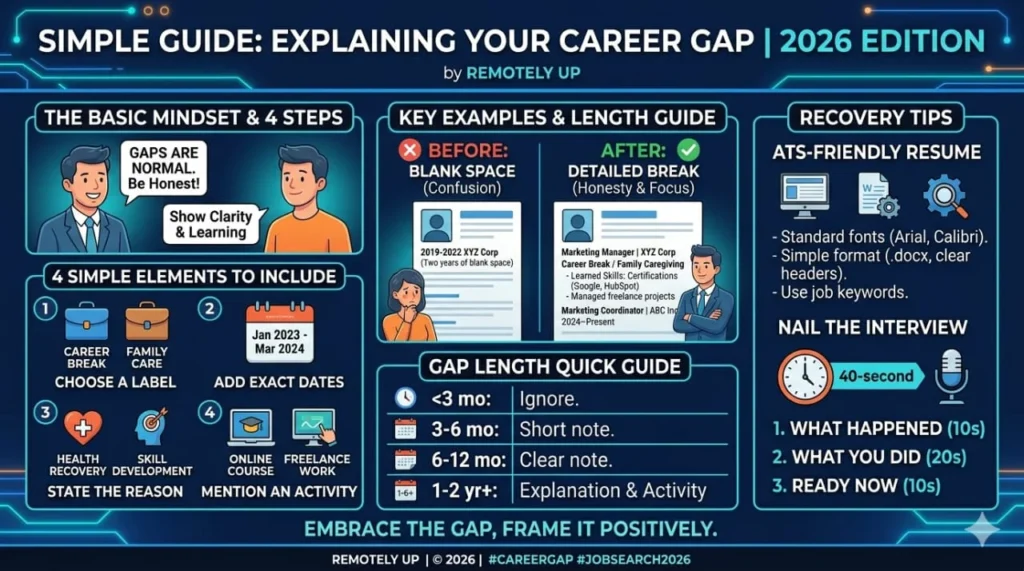
Explaining a career gap doesn’t have to be difficult. Just follow these simple steps:
- Pick a Label
Choose a clear label for the gap like “Career Break,” “Freelance Work,” or “Family Care.” This helps avoid confusion.
- Add Dates
List the exact start and end dates (e.g., Jan 2023 – Mar 2024). Avoid using vague terms like “recently.”
- State the Reason
Write a short, honest reason for the gap:
Family caregiving
Health recovery
Skill development - Mention an Activity
Include one thing you did during the gap, like:
“Completed online course”
“Freelanced for clients” - Put It Together
Your entry could look like this:
Career Break | Jan 2023 – Mar 2024
Family caregiving
Completed Project Management Certificate - Practice Your Answer
In an interview, say:
“I took a break for [reason] and used the time to [activity]. I’m now ready to work.”
Real Resume Example of Career Break in Resume
The “Before-and-After” section shows how explaining your career gap with clear dates and activities improves your resume. Before, it looks incomplete, but after adding the gap with skills learned, it becomes more honest, confident, and attractive to recruiters. See exactly what to change.
Before
Marketing Manager | XYZ Corp | 2019 – 2022
(two years of blank space)
Marketing Coordinator | ABC Inc | 2024 – Present
After
Marketing Manager | XYZ Corp | 2019 – 2022
Career Break | Family Caregiving | 2022 – 2024
– Completed Google Analytics and HubSpot certifications
– Managed freelance social media projects for 2 businesses
Marketing Coordinator | ABC Inc | 2024 – Present
Same person, same time.
The second version looks strong and honest.
What Is a Career Gap?
A career gap is a period when you were not working in a full-time job. A strong resume summary can help you explain your experience better and highlight your skills. Learn how to write it in our guide: How to Write a Resume Summary: A Simple 2026 Guide.
This includes:
- Time between jobs
- Family care
- Layoffs
- Health recovery
- School or courses
- Freelance work
Gap Length Guide
| Gap Length | What It Means |
|---|---|
| Under 3 months | Usually ignored |
| 3 to 6 months | Needs a short note |
| 6 to 12 months | Needs a clear note |
| 1 to 2 years | Needs explanation and activity |
| 2 years or more | Needs strong explanation |
If your break was under three months, you are likely fine.
If it was longer, keep reading.
Is a Resume Gap a Problem in 2026?
A career gap is not a problem by itself. Most people take breaks at some point for family, health, education, travel, or personal reasons. Recruiters mainly want to know what happened during that time. A short explanation is usually enough.
Recent 2026 hiring market data shows that 91% of hiring managers are fully open to interviewing candidates with career breaks.
What Recruiters Think
Recruiters ask three quick questions when they see a gap.
1. Is There an Explanation?
If they see a blank space, they move on.
If they see a note, they keep reading.
2. Did You Stay Active?
Small things help:
- Online courses
- Freelance work
- Volunteer work
- Personal projects
3. Are You Ready Now?
Recruiters need to know your skills are current.
Your resume should show this clearly.
78 percent of hiring managers will hire someone with a gap if explained clearly.
How to Write a Career Gap on Your Resume: 3 Methods
There are three simple ways to do this.
Method One: Add a Labeled Entry
Best for: Breaks of six months or more.
Template:
[Label] | [Date Range]
[One-line reason]
- [Activity or skill learned]
Example:
Career Break | Jan 2023 – Mar 2024
Family care and learning
- Completed Google Project Management Certificate
Method Two: Use One Clear Line
Best for: Shorter breaks of three to six months.
Example:
Career Break (Nov 2023 – Apr 2024): Family care. Completed Scrum Master course.
Method Three: Show Activity First
Best for: When you did freelance or volunteer work.
Example:
Freelance Writer | 2023 – 2024
- Wrote 40 articles for 3 business clients
- Completed HubSpot Content Marketing Course
Which Method to Choose?
If unsure, pick Method One because it is the safest. Also read: Resume Format: PDF or Word?
How to Write Your Break (With Examples)
This section shows practical examples of how to present career gaps on your resume. Learn how to label your gap, highlight any skills or activities, and present yourself as ready to return to work.
Example 1: Family Care
❌ Before: (Blank space)
✅ After:
Career Break | Family Caregiving | 2022 – 2024
- Full-time care for family member
- Completed Google Analytics Certification
Example 2: Post-Layoff
❌ Before: Unemployed
✅ After:
Professional Development | 2023 – 2024
- Job ended due to company layoff
- Completed AWS Solutions Architect certification
Example 3: Health Recovery
❌ Before: Dealing with health issues
✅ After:
Career Break | Health Recovery | 2023 – 2024
- Took time for personal health
- Now fully recovered and ready
Example 4: Freelance Work
❌ Before: Looking for work
✅ After:
Freelance Graphic Designer | 2023 – 2024
- Designed logos and ads for 4 clients
- Managed client deadlines alone
Where to Place a Career Break in Your CV
Deciding where to place a career gap on your resume can make a big difference in how it’s perceived. The ideal placement depends on the length of your gap and the activities you engaged in during that time.
To ensure your career gap is explained correctly on your resume, you can refer to professional HR guidelines from source like Indeed’s Resume Tips.
Option A: Work Experience Section (Best)
Add the gap like a job entry.
Recruiters read work history in order. It flows well.
Option B: Summary at the Top
Mention it early if the gap is big.
Example:
Marketing pro with 7 years of experience. Returning from a one-year break for family care. Completed Google Analytics courses.
Option C: Certifications Section
List courses with dates. The dates fill the gap.
ATS Tips for Explaning Employment Gaps
ATS stands for Applicant Tracking System.
It scans your resume before a human sees it. Learn how an ATS resume works in our guide on ATS Resume
Formatting Rules
Always do:
- Use standard fonts like Arial or Calibri
- Use clear headings
- Save as .docx file

Never do:
- Use text boxes or tables
- Use two columns
- Use icons or graphics
Keyword Strategy
ATS looks for words from the job description. Use those exact keywords in your resume gap entry.
Example:
Professional Development | 2023 – 2024
- Completed Salesforce Administrator course
- Built data dashboards using Excel
Date Formats
Good: Jan 2023 – Mar 2024
Bad: Recently, Last year, (blank)
How to Explain a Career Gap in an Interview
Use the 3-Part Formula. It takes 40 seconds.
The Formula
- What happened (10 seconds): “I took a break to care for a family member.”
- What you did (20 seconds): “I completed a project management course and did freelance work.”
- Why you are ready (10 seconds): “That is done now. I am ready and excited to work.”
Full Script
“I took a break in 2023 to care for a family member. During
that time, I completed a project management course and did some freelance work. That is done now. I am ready and excited to bring my skills to this role.
Not getting interviews? Read our guide: Why Your Resume Isn’t Getting Interviews.
Words to Avoid
| Avoid This | Say This Instead |
|---|---|
| “I know it looks bad…” | “Here is what happened…” |
| “Sorry about the gap.” | (Do not say sorry.) |
| “I was not doing anything.” | “I used the time to learn…” |
Final Thoughts
Remember, a career break does not automatically hurt your chances of getting hired. A clear explanation and an updated resume can help employers focus on your skills instead of the gap.
Recruiters value clear and honest work history, and a career gap is simply one part of your story. It only becomes an issue if you try to hide it. By labeling your gap, explaining it clearly, and showing what you did during that time, you can present yourself as proactive and ready to re-enter the workforce. Before writing also read our guide Can ATS detect Chatgpt wtiting in a resume.
Embrace the gap, frame it positively, and confidently walk into interviews knowing that you have nothing to hide.
Frequently Asked Questions
Simply label the gap with exact dates and mention any activities or learning you did during that time. Clarity is key, so focus on what you achieved.
Absolutely! As long as you show recent activity, like courses or projects, employers want to see your current skills. Update your resume with relevant work.
Keep it general. For example: “Career Break | Health Recovery.” You don’t need to go into specifics, just reassure employers that you’re now ready for work.
Yes, it definitely does. List your freelance roles as full jobs, with results and skills. This helps avoid the appearance of a gap.
There’s no strict rule. Short breaks usually don’t need explanation, but longer ones require clear context and readiness to return to work.
Ready-to-Use CV Templates for Explaining a Career Break
TEMPLATE 1: Family Care
Career Break | [Month Year – Month Year]
Full-time care for family
- [Course completed]
- Now available for work
TEMPLATE 2: Post-Layoff
Professional Development | [Year – Year]
Job ended due to restructuring
- Completed [course name]
- Seeking [type of role]
TEMPLATE 3: Health Recovery
Career Break | [Month Year – Month Year]
Personal health recovery, now resolved
- Ready for full-time work
TEMPLATE 4: Freelance Work
[Job Title] | [Year – Year]
- [Result or number]
- [Skill or tool used]
TEMPLATE 5: Learning Period
Full-Time Learning | [Year – Year]
- Completed [course name]
- Built [project name]
Found this guide helpful? Share it with someone who needs it.